.png)
USC STEAM 2025: LMF Building Brick Set
- Randi Fish

- Apr 27
- 5 min read
Problem
EAFab wanted to develop a building-brick set of their signature LMF to be used as a client giveaway. After exploring options with major manufacturers like LEGO, they found that the quoted costs were far beyond a reasonable budget. To stay within their scope, they turned to the STEAM class to design a model that can be manufactured entirely in-house using their 3D printer.
This project simulates the cross-departmental collaboration that happens in real-world business operations, where multiple teams must coordinate and rely on each other to bring a product from conception to completion.
Our group was tasked with breaking down the CAD model of EAFab’s LMF and Ladle to turn it into a building brick set roughly the size of a soda can. The final design should have a high piece count and have a functional gator-mouth skirt.
Process
The ladle serves as the base for the entire model. This means that if the dimensions or angles are wrong on the ladle, they will also be wrong on the Gator-Mouth LMF and the top plate. After determining what type of studs and holes to use for our model, we were able to start creating the ladle.

We thought it would be best to start with a base plate that takes up the entire bottom of the model, just like LEGO does in their sets. This allows the model to be stable and not fall apart at the base. For the main ladle pieces, we created quarter circles that had a constant angle throughout the layers. This allowed the ladle to grow taller and wider at the same time.
Since our goal was to include as much detail as we could while maintaining functionality, we also included special, detailed pieces throughout the ladle.

The first of these special pieces is the first brace piece. This piece is meant to show the lower rib that goes around EAFab’s ladle. These pieces are still quarter circles, but they are half the height of the generic ladle pieces, and they have chamfers to make them look like the ladle ribs. The next special pieces are the trunnion pieces.
These are the handles that the ladle would use to rest on the stand. Two trunnion pieces stack to create a trunnion.


The piece above and to the right is the second brace. This is the same as the first brace, but it has a wedge to hold the small molten steel pieces in place.

The final unique pieces in the ladle are the top pieces. They connect to the top plate and provide mounting points for the gator mouth.
In conclusion, the ladle is the largest part of the model, but it still contains details while keeping its functionality. It is the ground upon which all the other pieces rest.
Ladle Metallurgical Furnace (LMF)
The LMF (The equipment piece resting at the top of the entire build) was particularly difficult to turn into a Building Block due to the many one-off, unique pieces that it required.
While there were easy parts to make, such as the vent stack and the off-gas duct, there were multiple really complicated parts, such as the center stack and the trap door.

The center stack, the triangular-shaped piece in the middle of the top plate, was especially hard to turn into a building block. It wouldn't fit well as a building block in the early models, and when we were able to get something to work, it was hard to find the specific orientation that it needed to go in. Eventually, we figured out how to break it up into three smaller triangles that made it work well.

The final challenge was the top plate itself, which went through many iterations. It started as a circle with multiple studs evenly spaced atop it, but eventually transformed into what it is now - studs only where needed and a flat top.
Gator-Mouth Skirt
Designing the Gator-Mouth Skirt was a particularly interesting section of this project. Straying from a stationary design, the gator mouth needed to fit snugly within itself, attach tightly to the LMF, and still allow for motion without falling apart or breaking.
Towards the beginning of the project, we were mostly looking to use a scaled-down version of the original CAD model to preserve detail and smooth movement. Pictured below is the handle of the gator mouth made on the first day of the project; mainly, this was to get a feel for the scale of the final product rather than to test functionality.

After testing out several different alternatives, refining for strength and fit, we eventually settled on a more block-based design. Extending the handle allows for less wasted space with connecting pieces and less chance of the assembled set falling apart while in use.
The largest focus around mobility for this piece was to create a truly interactive experience, where the user can seek more information on the real-life complexities of the Gator-Mouth.
Ultimately, we ended with all pieces connecting in a singular base, totaling 9 pieces, and complete freedom of movement around the LMF.


Limitations
Printer Variation

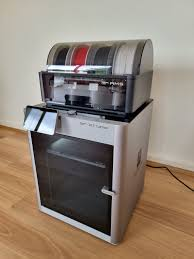


EAFab's Bambu Lab Printer USC High School's Prusa Printer
Throughout the design process, one of the main obstacles we encountered was the variation in prints between the two printers. While the printers we had direct access to were able to print sample testing pieces, all final designs had to be sent directly to EAFab to maintain correct tolerances. This process could take large amounts of time in between iterations, so keeping time focused and productive was another challenge we had to overcome.
Because the finished sets will be manufactured and built from the EAFab printers, cost reduction and flexibility of assembly were extremely high priorities during the design stages.
Material & Cost
Keeping in mind that many of these sets will be given away, a large consideration we had was keeping low cost as well as high stability, the core of optimization for an engineer. Having a very limited range of materials, we determined that PLA filament was the best option for a low-cost design. Essentially, the LMF’s fabrication was a three-way tradeoff between price, stability, and disassembly, of which no singular material could master.
Our Final Solution
The final product has an operational gator mouth that lifts up and down by a handle on the side. Additionally, the LMF lifts off the top, revealing many small red LEGO pieces representing the molten steel inside the ladle. The entire set consists of 100 pieces, with 24 unique pieces. The set shows great detail across many important aspects of the Ladle and LMF.


What We Learned
As individuals, this project was our first truly cooperative engineering design assignment. Over the course of our work, we learned lots about what it means to work cohesively as a group. Creating a detailed product, all the while learning communication and collaboration skills, truly allowed us to experience the pressure of real-world constraints. Improving our CAD skills, utilizing iterative design, and understanding fabrication were all large growth areas for our team.
If we had the opportunity to complete this project again, we are certain that we would prioritize communication and constructive criticism, putting our improved skills to work.


Comments